

A practical vision for keeping the DRAP permanently protected, actively farmed, economically viable, well-stewarded, and resilient for generations to come.
Report Now Available
The Ontario Farmland Trust has released Future Vision for the Duffins Rouge Agricultural Preserve (DRAP), a report that sets out a practical, forward-looking vision for the agricultural future of one of Ontario’s most significant protected agricultural landscapes.
The report brings together research, policy review, agricultural land use analysis, community engagement, farmer and agricultural stakeholder input, resident outreach, survey feedback, and landowner correspondence. Its purpose is to identify the conditions, partnerships, policy directions, and implementation actions needed to support the DRAP as a permanently protected, actively farmed, economically viable, well-stewarded, and resilient agricultural area.
This report is a vision and strategic framework prepared by the Ontario Farmland Trust with support from the Greenbelt Foundation. It is not a statutory land use plan, legal opinion, development approval, or regulatory decision, and it does not change property ownership, private property rights, agricultural easement terms, zoning, or land use permissions. The report does not prescribe what individual farmers should grow or how farm businesses should operate. Implementation of any recommendation would require appropriate legal, policy, planning, funding, landowner, farmer, Indigenous, agency, and community engagement processes. The DRAP is made up largely of privately owned and actively farmed land; publication of this report does not create public access rights to private property.
What Is the Duffins Rouge Agricultural Preserve?
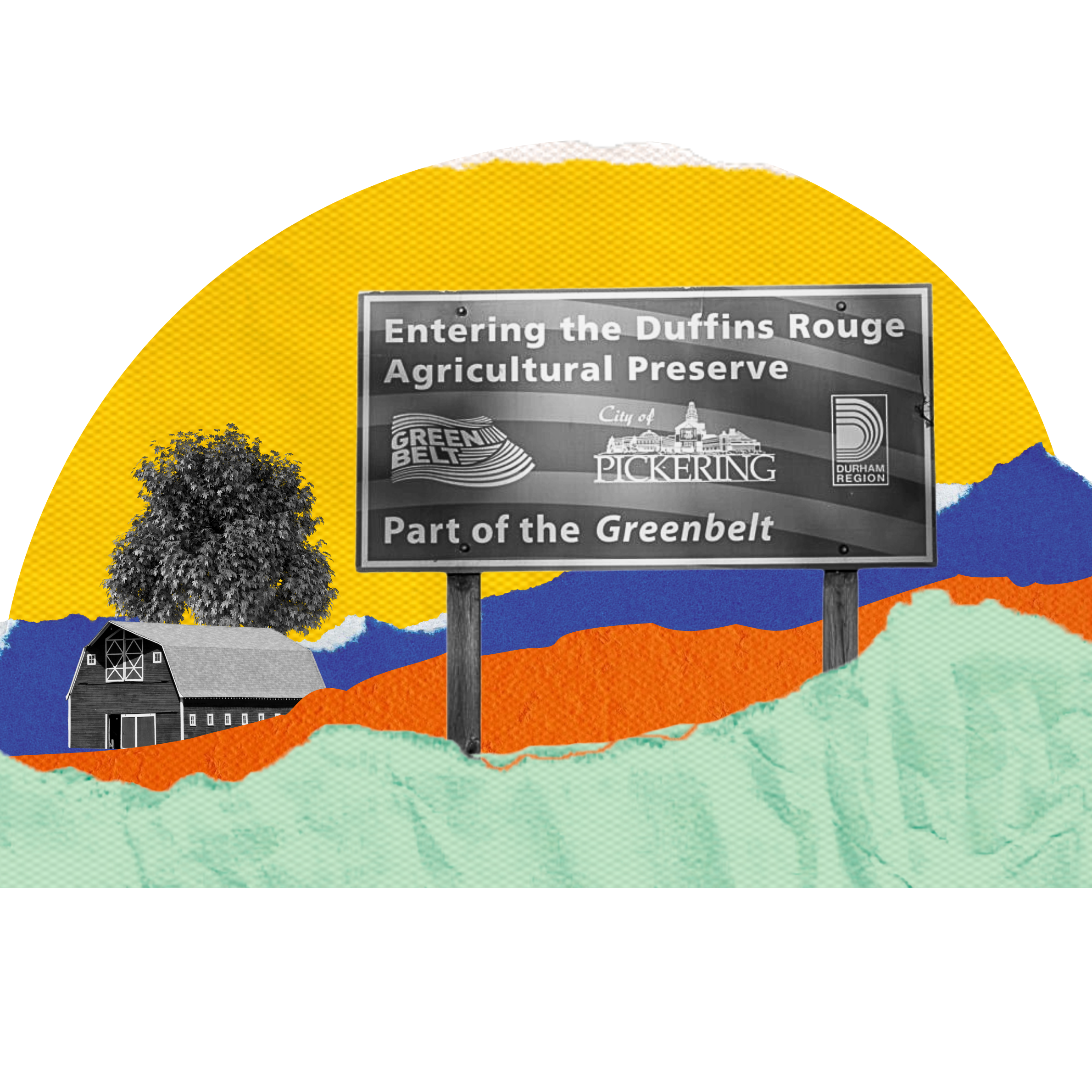
The Duffins Rouge Agricultural Preserve, known as the DRAP, is a protected agricultural landscape in Pickering, within Durham Region and Ontario’s Greenbelt. It covers approximately 4,700 acres and continues to support active farming today.
The DRAP is important because it contains high-quality agricultural land in one of Canada’s most growth-pressured regions. Its value is not only in the land itself, but in the farming, stewardship, infrastructure, agricultural knowledge, and public commitment needed to keep it functioning as a working agricultural landscape over time.
Why a Vision Was Needed
Recent events showed that even highly protected agricultural lands can remain vulnerable to political and development pressure. The repeal of DRAP protections and removal of the lands from the Greenbelt in 2022, followed by the reinstatement of protections in 2023, reinforced the need for a clear vision that addresses both permanent protection and the practical conditions needed for agriculture to remain viable.
The central finding of the report is simple: permanent protection is essential, but protection alone is not sufficient for a strong and resilient agricultural future. The DRAP’s long-term success will depend on whether the land remains actively farmed, economically viable, well-stewarded, publicly understood, and supported by the land use policy, infrastructure, ownership, tenure, and Agricultural System conditions needed for farming to thrive.
How the Report Was Developed
The DRAP Vision Report was developed through a multi-stage process that combined research, planning analysis, engagement, and review.
Stage
Research and policy review
What happened
Review of the DRAP’s history, Greenbelt and DRAP Act protections, planning framework, agricultural easements, land use context, and relevant agricultural policy.
Agricultural land use and mapping analysis
Review of agricultural land capability, production patterns, infrastructure, natural heritage, and the broader agricultural system in and around the DRAP.
Public survey
A public survey was open from June 9 to September 1, 2025 and received 70 responses. The survey was used as an engagement tool to identify recurring themes, concerns, aspirations, and areas of interest.
Community workshop
A facilitated community workshop was held on September 15, 2025 at the Whitevale Community Centre. Participants worked in small groups to identify agricultural opportunities, draft vision statements, and discuss conditions needed to support a stronger agricultural future.
Resident outreach
Door-to-door and direct outreach with residents living within and near the DRAP helped identify community perspectives on farmland protection, development pressure, local food, ecological features, and public understanding of the Preserve.
Farmer and agricultural stakeholder input
Conversations with farmers and agricultural stakeholders helped ground the report in practical realities such as land access, leases, drainage, field entrances, infrastructure, equipment movement, markets, and farm investment.
Landowner correspondence
Correspondence and supporting materials from landowners whose holdings comprise a significant proportion of the land within the DRAP were reviewed as part of the project.
Drafting and review
The report was refined through internal review, committee feedback, reviewer comments, and revisions focused on clarity, balance, implementation, and public readability.
What We Heard
The engagement process did not produce a single consensus view, and the report recognizes that different people and organizations have different perspectives on the future of the DRAP. However, several recurring themes emerged across the research and engagement:
- Strong support among many residents, community participants, and agricultural stakeholders for maintaining the DRAP as a protected agricultural landscape.
- Concern that long-term protection must be durable, actively implemented, and resilient to shifting political priorities.
- Recognition that the DRAP’s agricultural land base is highly capable and continues to support active production.
- Implementation of any recommendations must be framed to ensure they support the farmers who are keeping the DRAP actively and productively farmed.
- There is community interest in greater agricultural diversity, local food opportunities, farmgate sales, public education, and stronger community connection. However, these opportunities should be farmer-led and pursued only where they are viable, compatible with active farming, and do not displace or undermine existing farm operations.
- A need for better public awareness of what the DRAP is, why it exists, how it differs from a park, and why high-quality farmland cannot simply be replaced elsewhere.
- A need for coordinated implementation, clear accountability, funding, monitoring, and ongoing review.
The Vision Statement
The Duffins Rouge Agricultural Preserve will be a permanently protected, highly productive, well-stewarded and economically viable agricultural area that sustains current farm operations, supports future generations of farmers, and demonstrates the long-term public value of protection of farmland within Ontario.
What the Report Recommends
The report organizes its recommendations around the idea that the DRAP should not only be protected from non-agricultural development, but supported as a functioning agricultural landscape.
- Strengthen and align long-term protection mechanisms.
- Keep the DRAP actively farmed and agriculturally productive.
- Improve land access, tenure security, landowner alignment, and new farmer pathways.
- Activate underutilized and strategically located lands for agriculture where appropriate.
- Strengthen agricultural viability in a near-urban context.
- Enable farmer-led diversification and local food opportunities.
- Strengthen the broader Agricultural System and agricultural support network.
- Coordinate infrastructure, servicing, and land use planning with agricultural needs.
- Advance ecological stewardship within an agriculture-first landscape.
- Improve public awareness, identity, and respect for the DRAP.
- Establish clear governance, funding, timelines, accountability, monitoring, and ongoing review.
What Happens Next
The DRAP Vision Report is intended to support conversation, coordination, and action among the many partners whose decisions affect the future of the DRAP. Implementation will require shared responsibility among the Province, Durham Region, the City of Pickering, farmers, landowners, agricultural organizations, conservation partners, infrastructure agencies, community food partners, and the broader community.
The report recommends establishing a coordinated implementation structure, developing a multi-year implementation plan with near-term, medium-term, and long-term actions, and reviewing the vision, implementation plan, metrics, and reporting framework over time so that progress can be tracked and priorities can be updated as conditions change.
Frequently Asked Questions
Does the report change land use permissions?
No. The report is a vision and strategic framework. It does not change zoning, property rights, easement terms, or land use permissions.
Does the report create public access to DRAP farmland?
No. Much of the DRAP is privately owned and actively farmed. Visitors should respect private property, normal farm practices, and farm operations.
Does the report tell farmers what to grow?
No. The report recognizes farmers as central decision-makers. It supports farmer-led opportunities where they are viable, appropriate, and compatible with the agricultural purpose of the lands.
Who needs to be involved in implementation?
Implementation will require shared responsibility among governments, farmers, landowners, agricultural organizations, conservation partners, infrastructure agencies, community food partners, and the broader community.